March 13, 2026
What Is the Impact of the US-Iran War on Building Material Prices in 2026?
The Impact of the US-Iran War on Building Material Prices in 2026 The US-Iran conflict that escalated in early 2026...

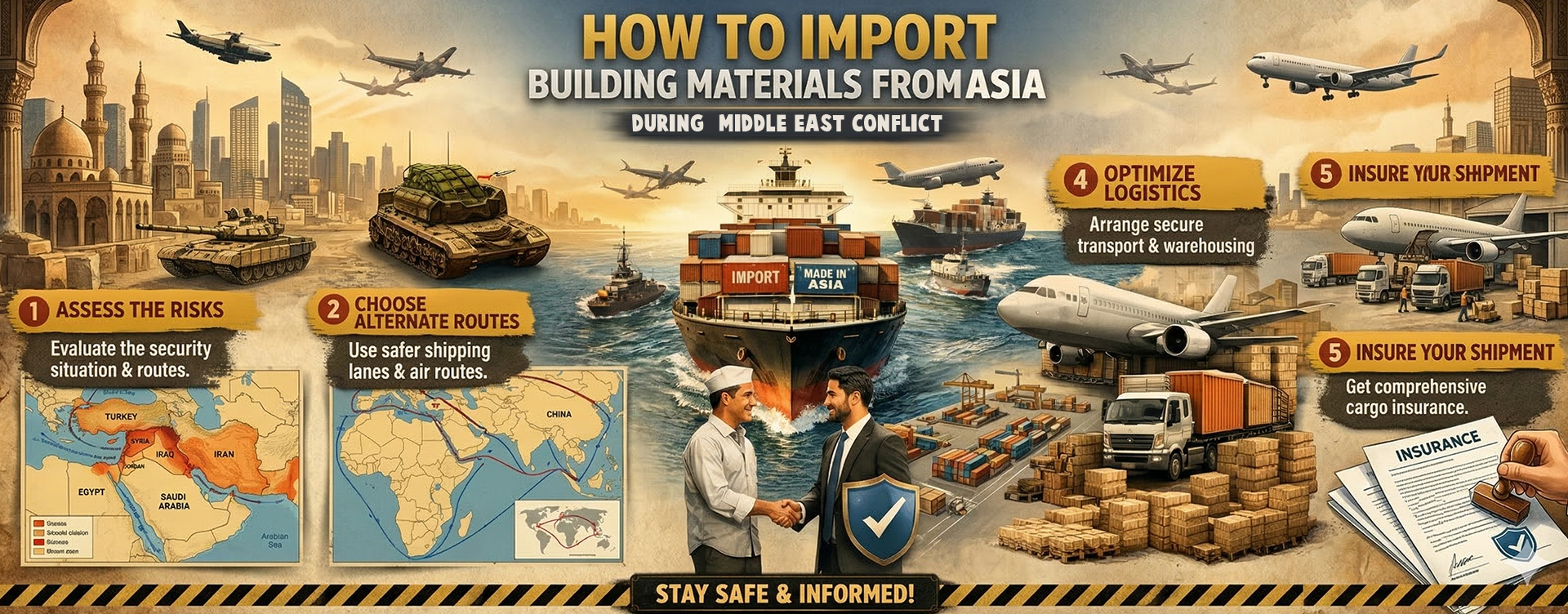
Middle East Building Material Supply Chain Under Pressure – March 2026 Conflict Update
The Middle East conflict between US, Israel & Iran that escalated in early March 2026 has sent shockwaves through the entire region – from the Arabian Gulf to the Levant, from the Red Sea to the Mediterranean. No importer, distributor, or contractor across the Middle East is untouched. Whether you are in Dubai, Riyadh, Doha, Kuwait City, Manama, Muscat, Amman, or Cairo, your building material supply chain is under unprecedented pressure.
This is not a localized disruption. It is a regional crisis affecting every Gulf state and Middle Eastern economy. Understanding the full scope of the impact is the first step toward protecting your business and securing your supply lines.
The Regional Scope : Why Every Middle East Building Material Importer Is Affected
The conflict has created immediate and severe disruptions across the entire Middle East. Critical chokepoints, major ports, and essential trade routes are impacted simultaneously.
Critical Maritime Chokepoints Under Pressure
| Chokepoint | Status | Countries Affected |
|---|---|---|
| Strait of Hormuz | Effectively halted; ~20 dry bulk vessels per day normally | UAE, Saudi Arabia, Kuwait, Qatar, Bahrain, Iraq, Iran |
| Bab el-Mandeb Strait | High risk; major carriers rerouting | Saudi Arabia, Yemen, Djibouti, Eritrea, Sudan |
| Suez Canal | Reduced traffic; insurance surcharges applied | Egypt, Mediterranean importers, Red Sea states |
| Red Sea Shipping Lanes | Active conflict zone; carriers avoiding | Saudi Arabia, Jordan, Egypt, Sudan, Eritrea |
Nearly 30 million tonnes of dry bulk trade per month – over 7% of global dry bulk shipping demand – passes through these waters. A significant portion of this is building materials: steel, cement, ceramics, and construction inputs destined for the region’s ongoing development projects. That trade is now severely disrupted.
Major Ports Across the Region : Current Status
| Country | Port | Current Status |
|---|---|---|
| UAE | Jebel Ali (Dubai) | Partially suspended; 200+ vessels waiting |
| UAE | Khalifa (Abu Dhabi) | Partially operational |
| UAE | Fujairah | Operating but heavily congested |
| UAE | Sharjah | Operating but heavily congested |
| Saudi Arabia | Jeddah Islamic Port | Reduced operations; Red Sea security concerns |
| Saudi Arabia | King Abdulaziz (Dammam) | Operating; increased volume from diversions |
| Qatar | Hamad Port | Operating; congestion increasing |
| Kuwait | Shuwaikh | Operating; delays reported |
| Bahrain | Khalifa bin Salman | Operating; contingency planning active |
| Oman | Sohar | Operating; positioned as alternative hub |
| Oman | Salalah | Operating; Red Sea diversion point |
| Jordan | Aqaba | Reduced operations; Red Sea access impacted |
| Egypt | Port Said | Suez Canal knock-on effects |
| Egypt | Alexandria | Mediterranean routing changes |
The common thread: every port in the region is either directly impacted or bear increased pressure from diverted cargo. There is no “business as usual” anywhere in the Middle East for building material imports.
Beyond Shipping : The Broader Regional Impact
The conflict’s effects extend far beyond port congestion. Understanding the full economic context helps building material importers make better strategic decisions.
Impact on Oil and Energy
The Middle East accounts for approximately one-third of global oil production. The conflict has :
For building material importers, this means higher costs for goods manufactured using energy-intensive processes, and potential delays in construction projects dependent on government spending. Every ton of steel, every crate of tiles, every batch of construction chemicals now carries an embedded energy cost premium.
Impact on Food Security and Its Spillover Effects
The Middle East imports 85% of its food – one of the highest rates globally. The conflict has :
For importers of building materials, the food security context matters because :
Read More About GCC’s Building Materials Product Range
Impact on Construction and Infrastructure Pipeline
The building material supply chain is particularly vulnerable to the current disruption :
| Factor | Impact on Building Material Imports |
|---|---|
| Steel shipments | Bulk carriers most affected by Hormuz disruption |
| Cement and aggregates | Heavy, low-value; margins squeezed by freight increases |
| Ceramics and tiles | Fragile; longer transit increases breakage risk |
| Construction chemicals | Hazardous shipping restrictions; documentation delays |
| Laminates and panels | Moisture risk during extended transit |
| Furniture hardware | Just-in-time inventory at risk; project delays |
| PVC and plastic products | Energy-intensive; cost pressure from oil prices |
| Sanitaryware | Bulky, fragile; container utilization challenges |
The Currency and Financial Dimension
| Factor | Impact on Building Material Importers |
|---|---|
| Gulf currencies | Pegged to USD; stable but import costs rising |
| Egyptian pound | Continued pressure; import financing difficult |
| Jordanian dinar | Stable but tourism revenue affected |
| Lebanese lira | Already stressed; crisis deepens |
| Letters of credit | Becoming harder to open; banks risk-averse |
| Payment terms | Suppliers demanding shorter terms; advance payments |
| Working capital | Extended timelines tie up cash; financing harder |
For importers, this means financing costs are rising and payment structures are tightening – even as goods become more expensive and delayed.
Read More About GCC’s PVC Product Range
What This Means for Building Material Importers Across the Region
Regardless of what building materials you import or where you are located in the Middle East, you are facing :
| Challenge | Regional Impact |
|---|---|
| Timeline unpredictability | When will orders arrive? No one can say with confidence – from Jeddah to Jebel Ali to Aqaba |
| Cost volatility | Shipping and insurance rates change weekly, sometimes daily, affecting every Gulf state |
| Supplier reliability | Can your existing partners deliver through the disruption? Many cannot |
| Documentation complexity | Changing regulations and port requirements vary by country |
| Inventory pressure | Balancing stockouts against overstocking in uncertain times |
| Project delays | Construction timelines slip; penalty clauses triggered |
| Working capital strain | Extended timelines tie up cash; financing harder to secure |
| Competitive positioning | Will you lose market share to importers with better supply chains? |
| Customer relationships | Can you keep your commitments when your suppliers cannot? |
| Margin compression | Rising costs + fixed contracts = shrinking profitability |
Read More About GCC’s Steel Product Range
Why Asian Sourcing Remains Essential for Middle East Building Material Importers ?
Despite the disruption, Asia remains the most viable sourcing region for building materials. The question is not whether to source from Asia – it is how to do it reliably during the crisis.
Asia’s Critical Role in Middle East Construction
| Material Category | Primary Asian Sources | Why Asia Matters |
|---|---|---|
| Steel and metal products | India, China | Cost advantage; production scale; grade availability |
| Ceramics and tiles | India, China | Design range; price points; volume capacity |
| Laminates and plywood | India, Southeast Asia | Quality grades; moisture resistance; finish options |
| Construction chemicals | India | Technical formulations; Middle East climate adapted |
| PVC and plastic products | India, China | Energy cost advantage; complete product range |
| Furniture hardware | India | Precision manufacturing; finish quality; mechanism durability |
| Sanitaryware and fittings | India, China | Price competitiveness; design flexibility |
| Stone and marble | India, Turkey | Variety; quality; processing capabilities |
The Challenge : Finding Reliable Supply Partners
The crisis has exposed the fragility of fragmented sourcing :
| Traditional Problem | Crisis Amplification |
|---|---|
| Multiple suppliers, multiple headaches | Each supplier becomes a failure point |
| Agent takes commission, you take risk | Agents cannot solve logistics crises |
| You manage logistics and documentation | Complexity multiplies with disruption |
| Quality varies by factory | No time for rework or replacements |
| Payment risk with unknown suppliers | Financial exposure increases |
| Communication gaps | Delays multiply when information is slow |
| Inconsistent documentation | Customs clearance becomes nightmare |
The solution is not more suppliers. It is better partners – partners with verified manufacturing networks, proven logistics, complete documentation, and single-point accountability.
Strategic Approaches for Building Material Importers
Based on current market intelligence and industry best practices, here are actionable strategies for protecting your building material supply chain during the conflict.
1. Diversify Your Port Strategy
With every major port under pressure, proactive redirection is essential:
| Strategy | Implementation |
|---|---|
| Map alternative ports | Identify 2–3 options per destination country |
| Oman as hub | Sohar and Salalah positioned as stable alternatives |
| Overland options | Consider entry via Saudi or Oman with trucking |
| Book well ahead | 3–4 weeks minimum for confirmed slots |
| Work with experts | Freight forwarders with regional relationships |
| Maintain flexibility | Be ready to redirect vessels on short notice |
| Build relationships | Multiple port contacts = multiple options |
2. Consolidate to Optimize
| Strategy | Implementation |
|---|---|
| Reduce supplier count | Fewer, deeper relationships outperform many shallow ones |
| Mix product categories | Combine steel, tiles, hardware, chemicals in one container |
| Plan container utilization | Optimize every cubic meter; reduce per-unit freight cost |
| Forecast jointly | Share projections with your consolidation partner |
| Standardize where possible | Fewer SKUs = easier consolidation |
| Think in containers, not products | Optimize the whole shipment, not individual items |
3. Build Strategic Inventory
The just-in-time era is temporarily suspended across the Middle East :
4. Strengthen Partner Relationships
| Strategy | Implementation |
|---|---|
| Communicate proactively | Share forecasts and contingency plans; don’t wait for problems |
| Consider long-term agreements | Secure capacity and priority allocation |
| Reduce supplier count | Deepen relationships with fewer, verified partners |
| Visit virtually or in-person | Assess capabilities firsthand; build trust |
| Build trust | Reliable partners get priority during crunch |
| Share pain, share gain | Long-term partnerships survive short-term disruptions |
| Document everything | Clear records prevent disputes |
5. Build Cost Contingencies
| Cost Factor | Contingency Approach |
|---|---|
| Shipping | Factor 30–50% increases into landed cost models |
| Insurance | Budget for 50% higher premiums |
| Transit time | Add 15–20 days to delivery timelines for planning |
| Material costs | Build 15–20% buffers into project quotes |
| Currency | Hedge if exposure is significant; monitor exchange rates |
| Financing | Secure lines before they tighten further |
| Buffer stock carrying cost | Factor into inventory decisions |
| Expediting costs | Budget for emergency air freight if needed |
6. Fix What You Can Control
Amidst all the uncertainty, focus on what you can actually influence :
Global Connect Corporation (GCC) : Your Building Material Sourcing Partner
Global Connect Corporation (GCC) stands ready to support importers across the Middle East with stable, high-quality building materials from Asia – all with complete accountability and end-to-end support. With 200+ verified manufacturing units, 500+ shipments executed, and 12+ countries supplied, GCC brings proven capability to your most critical supply chain challenges.
Who We Are
| GCC at a Glance | |
|---|---|
| Verified Manufacturing Units | 200+ across Asia |
| Export Shipments Executed | 500+ |
| Countries Supplied | 12+ across Middle East and beyond |
| Product Categories | Complete building material portfolio |
| Operational Model | Direct supply; end-to-end accountability |
| Quality Approach | Batch-wise QC; third-party inspection available |
| Documentation | Complete export and customs compliance |
All shipments are executed under GCC’s export management, documentation, and payment framework, ensuring consistency, compliance, and reliability. We do not pass risk to you – we manage it.
GCC’s Building Material Portfolio
| Category | Products |
|---|---|
| Steel | Plates, sections, pipes, MS sheets, roofing |
| Cement | OPC, PPC, specialized grades |
| Tiles & Ceramic | Floor tiles, wall tiles, vitrified, porcelain |
| Laminates & Plywood | HPL, marine grade, BWR, compact laminates, digital |
| PVC & WPC | Foam boards, WPC doors, SPC flooring, edge banding |
| Construction Chemicals | Waterproofing (cementitious + liquid), adhesives, grouts, sealants |
| Furniture Hardware | Hinges, handles, drawer systems, soft-close, locks |
| Stone | Granite, marble, sandstone |
| PVC Pipes | Pressure pipes, drainage, fittings |
| Sanitaryware | WC, basins, cisterns, faucets |
| Plastiwcare | Household essentials, storage, waste management |
What Makes GCC Different
| Traditional Approach | GCC Approach |
|---|---|
| Multiple suppliers across Asia | Single partner with verified manufacturing network |
| Agent takes commission, you take risk | Direct supply with complete responsibility |
| You manage logistics and documentation | We manage end-to-end |
| Quality varies by factory | Batch-wise QC, third-party inspection |
| Payment risk with unknown suppliers | Structured payment framework |
| Crisis exposes weaknesses | Crisis proves resilience |
| You chase suppliers for updates | We provide real-time visibility |
| Documentation gaps cause delays | Complete compliance package every time |
How GCC Solves Your Building Material Sourcing Challenges ?
The GCC Solution : End-to-End Accountability
| Your Challenge | GCC Solution |
|---|---|
| Supplier fragmentation | Single source for complete building material portfolio |
| Quality inconsistency | 200+ verified manufacturing units; batch-wise QC |
| Documentation delays | Complete export documentation; customs compliance |
| Shipping uncertainty | Proven logistics; 500+ shipments executed |
| Payment risk | Structured payment framework; trade terms |
| Project deadlines | Reliable delivery; timeline visibility |
| Cost volatility | Stable pricing; consolidated freight |
| Crisis uncertainty | Proven partner with regional experience |
| Communication gaps | Single point of contact; real-time updates |
| Inventory pressure | Consolidated shipments; better planning |
The GCC Advantage for Middle East Importers
| Advantage | What It Means For You ? |
|---|---|
| Single-point accountability | One partner responsible from factory to port |
| Complete product range | Steel to sanitaryware in one container |
| Consolidation expertise | Mixed SKU containers optimize freight cost |
| Quality assurance | Batch-wise inspection; third-party available |
| Documentation completeness | Customs clearance support across the region |
| Regional experience | 12+ Middle East countries supplied |
| Flexible payment | Structured terms protect both parties |
| Crisis-tested | 500+ shipments; proven resilience |
| Supply chain visibility | Track your orders from production to delivery |
| Problem-solving orientation | We fix issues; we don’t create them |
Citation :





 0
0
 0
0 0
0 0
0