March 2, 2026
Cementitious vs Liquid Waterproofing
Cementitious vs Liquid Waterproofing – Which Performs Better in Middle East? Waterproofing failure in the Middle East is rarely a...

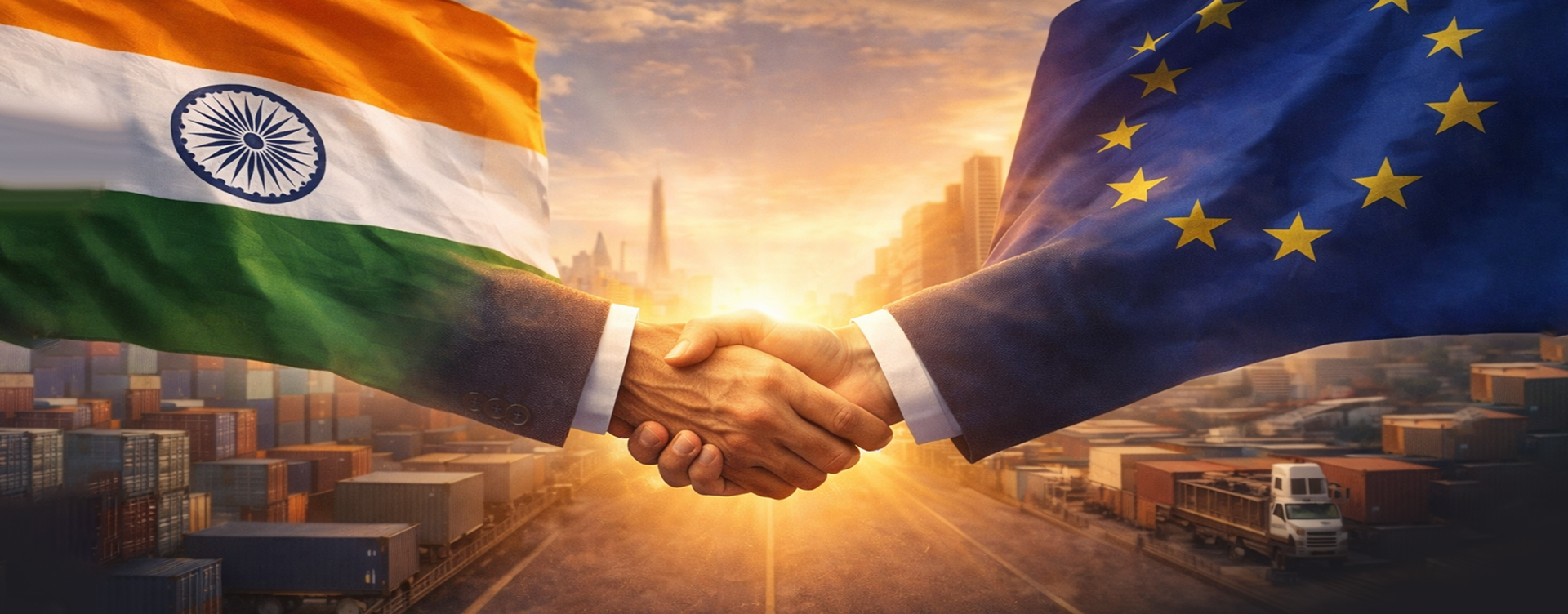
EU – India Free Trade Agreement: How It Could Reshape European Sourcing of Building Materials ?
The European Union and India are advancing toward signing a comprehensive Free Trade Agreement (FTA), with negotiations entering their final phase and a political agreement expected in early 2026. This deal builds on an already substantial bilateral goods trade corridor valued at approximately US$136 – 137 billion in 2024 – 25 (around €120 billion), where the EU ranks as India’s largest trading partner, accounting for about 11.5% of India’s total trade.
While the FTA will facilitate European exports of machinery, chemicals, and technology into India, its most transformative impact for EU importers lies in the reverse direction: enhanced access to Indian manufacturing capacity across industrial goods, including a wide range of building materials.
India already supplies the EU with US$77 billion in imports annually, including US$5.68 billion in iron and steel, US$426.70 million in ceramic products, US$362.74 million in stone/plaster/cement materials, and US$354.40 million in articles of stone/plaster/cement—asbestos/mica. These volumes demonstrate India’s established role as a reliable supplier today, but current Most Favoured Nation (MFN) tariffs often neutralise India’s ex-factory price advantages.
Today’s EU Building-Material Sourcing Landscape: Where Volumes Are Flowing ?
EU consumption of construction inputs—ranging from cement and steel to tiles, laminates, PVC products, construction chemicals, furniture hardware, and plasticware—remains steady, supported by renovation programs, infrastructure spending, and a projected 1.5% growth in construction output in 2026 after softer years in 2024 – 25.
However, importers face structural challenges: origin concentration risk (heavy reliance on China), policy uncertainty (CBAM reporting for steel/cement/aluminium from Q2 2026), and freight volatility (Red Sea disruptions, longer China routes).
Current EU Import Volumes from Key Origins (2024 – 25 Patterns)
| Product Family / Category | Primary EU Sourcing Origins (Share Est.) | India’s EU Export Value (2024) | Notes on India’s Position |
|---|---|---|---|
| Iron & Steel (HS 72 – 73) | China (dominant), Turkey, Ukraine | US$5.68 billion | India shipped 3.18 million tons of flat steel to EU in 2024 (+15.7% y/y); rebars/sections growing despite CBAM pressures. |
| Ceramic Products (HS 69) | China, Turkey, Spain, Italy | US$426.70 million | Strong mid‐range vitrified/ceramic tiles; global tile market US$510B by 2030 (India/China/Vietnam ~60% share). |
| Stone/ Plaster/ Cement Articles (HS 68) | China, intra-EU, Turkey | US$362.74M (articles) + US$354.40M (materials) | US$19.32M in cement/concrete/artificia l stone; established but tariff‐limited. |
| Plastics / PVC Products (HS 39) | China, Eastern Europe | ~US$2.2 – 2.5 billion (part of plastics) | Pipes, foam boards, profiles; growing steadily. |
| Wood/Plywood/Lami nates (HS 44) | China, Eastern Europe | Significant (plywood exports to EU countries like Hungary ~US$0.8M+) | Export plywood/allied products reached US$1.48 billion globally in 2023 – 24 (+6.81% CAGR). EU laminate market US$11.4B in 2024. |
| Furniture Hardware (HS 83) | China, Turkey | Part of US$876.99M furniture/lighting | Hinges, slides, handles; India gaining in SS/soft‐close grades. |
| Construction Chemicals (HS 38) | China, intra‐EU | Part of US$595.28M misc. chemicals | Global market US$48B in 2024 → US$72B by 2030 (6.8% CAGR); admixtures/waterproofin g ~55%. |
Data sources: UN COMTRADE 2024, EU Trade Policy, ITC Trademap. India is already a top‐10 supplier in steel, ceramics, and plastics to the EU, with volumes like 3.18 million tons of flat steel proving scale. However, MFN duties (6 – 10% on many lines) keep China/Turkey ahead on landed cost despite India’s lower ex‐factory prices.
Read More About GCC’s Building Materials Product Range
What the EU Gains: Export Advantages into India
For European exporters, the FTA opens doors to one of the world’s fastest‐growing markets by reducing or eliminating India’s high tariffs (often 10 – 20%+ on industrial goods) and streamlining regulations. Key EU wins include:
| EU Export Category to India (2024 Value) | Value (US$) | FTA Benefits for EU Exporters |
|---|---|---|
| Machinery & Appliances | US$12.52B | Lower duties (10 – 20% cuts); easier access for industrial equipment, engineering machinery. |
| Aircraft & Parts | US$6.96B | Preferential tariffs; supports India’s aviation growth. |
| Electrical/Electronic Equipment | US$5.10B | Regulatory alignment; boost for components and renewables. |
| Pharma Products | US$1.17B | Easier IP protection; growth in APIs and finished drugs. |
| Chemicals (Misc.) | US$1.43B | Tariff reductions up to 54%; specialty chemicals, dyes. |
| Iron/Steel & Articles | US$2.45B (combined) | Market access for high‐value alloys/tools. |
Total EU exports to India: US$52.34 billion in 2024, projected to grow significantly with services (IT, consulting) also benefiting. Wines/spirits (150 – 200% duties today) and premium autos (100 – 125% duties) gain easiest access, while machinery/chemicals scale via supply chains.
Read More About GCC’s Laminates Product
Pre-FTA Pricing: India’s Edge Is Neutralised by Duties
India’s manufacturing costs are competitive today, but duties create a barrier. Here’s a detailed table across 10+ categories:
| Product Category (Bulk B2B) | Origin | Approx. Ex‐Factory/FOB 2024 | Typical EU MFN Duty* | Est. Landed Cost Band** | India’s Current Edge |
|---|---|---|---|---|---|
| Ceramic/Vitrifie d Tiles (per m2) | China | US$4.10 | 0 – 2% | US$4.40 – 4.55 | – |
| Ceramic/Vitrifie d Tiles (per m2) | India | US$3.30 | 8 – 10% | US$4.55 – 4.70 | 20% cheaper ex‐works |
| Iron/Steel Flat Products (per MT) | China | US$620 | 0 – 3% | US$660 – 680 | – |
| Iron/Steel Flat Products (per MT) | India | US$560 | 7 – 9% | US$680 – 700 | 10% cheaper ex‐works (+3.18M tons shipped) |
| MS Sheets/Rebars (per MT) | Turkey | US$550 – 630 | 0% | US$600 – 680 | – |
| MS Sheets/Rebars (per MT) | India | US$560 | 7 – 9% | US$680 – 700 | Comparable ex‐works |
| PVC Pipes/Fittings (per MT) | China | US$920 | 0 – 2% | US$970 – 990 | – |
| PVC Pipes/Fittings (per MT) | India | US$780 | 6 – 8% | US$900 – 940 | 15% cheaper ex‐works |
| Cement (bulk, per MT) | Turkey | US$68 | 0% | US$75 – 78 | – |
| Cement (bulk, per MT) | India | US$52 | 8 – 10% | US$68 – 72 | 24% cheaper ex‐works |
| HPL Laminates (per m2) | China | US$4.20 | 0 – 3% | US$4.50 – 4.70 | – |
| HPL Laminates (per m2) | India | US$3.80 | 7 – 9% | US$4.70 – 4.95 | 10% cheaper ex‐works (EU market US$11.4B) |
| Plywood (export grade, per m3) | China | US$420 | 0 – 4% | US$460 – 490 | – |
| Plywood (export grade, per m3) | India | US$380 | 6 – 8% | US$450 – 485 | 10% cheaper ex‐works (global exports US$1.48B) |
| Furniture Hardware (SS hinges, 1,000 pcs) | China | US$180 | 0 – 3% | US$200 – 210 | – |
| Furniture Hardware (SS hinges, 1,000 pcs) | India | US$160 | 7 – 9% | US$210 – 225 | 11% cheaper ex‐works |
| Construction Chemicals (admixtures/kg) | China | US$1.10 | 0 – 2% | US$1.20 – 1.25 | – |
| Construction Chemicals (admixtures/kg) | India | US$1.40 | 6 – 8% | US$1.60 – 1.70 | Comparable (market US$48B→72B) |
| PVC Foam Boards/WPC (per m2) | China | US$4.50 | 0 – 3% | US$4.90 – 5.20 | – |
| PVC Foam Boards/WPC (per m2) | India | US$4.00 | 6 – 8% | US$4.80 – 5.20 | 11% cheaper ex‐works |
| Plasticware (watertanks/bins, per unit) | China | US$15 – 25 | 0 – 2% | US$17 – 28 | – |
| Plasticware (watertanks/bins, per unit) | India | US$12 – 20 | 6 – 8% | US$16 – 25 | 20% cheaper ex‐works |
* Indicative MFN ranges. ** Assumes standard freight/handling. Sources: GCC guides, COMTRADE 2024, Statista.
Reality check: India is already shipping significant volumes (e.g., 3.18M tons steel, ceramics US$427M), but duties neutralise the 10 – 24% ex‐factory edge across categories, keeping China/Turkey dominant on landed cost.
Read More About GCC’s Construction Chemcial Range
Step 1: Policy Context – Why Change Is Coming ?
The EU – India FTA will phase down duties on 90%+ of tariff lines over 5 – 10 years, including industrial goods like steel, ceramics, plastics, wood products, and chemicals—following precedents like EU – Vietnam (50%+ export growth post‐tariffs).
Simultaneously :
Result : India’s current volumes (US$5.68B steel, US$427M ceramics, etc.) are set to accelerate as duties fall and risks rise elsewhere.
Step 2: Post-FTA Pricing Scenarios – Slow Math Breakdown
Assume duties on Indian lines drop to 0 – 2% over time (realistic per EU FTAs). Here’s the transformation, category by category:
Likely Post‐FTA Landed Cost Shift Table (Illustrative)
| Product | India FOB (Today) | Pre-FTA Duty/Landed | Post-FTA Duty (Est.) / Landed | Est. % Savings vs Pre‐FTA India | vs China Today |
|---|---|---|---|---|---|
| Ceramic / Vitrified Tiles (per m2) | US$3.30 | 8 – 10% / US$4.55 – 4.70 | 0 – 2% / US$3.90 – 4.10 | 10 – 15% | ↓11 – 15% |
| Iron / Steel Flat (per MT) | US$560 | 7 – 9% / US$680 – 700 | US$620 – 640 | 6 – 8% | ↓6 – 8% |
| MS Sheets/Rebars (per MT) | US$560 | 7 – 9% / US$680 – 700 | 0 – 2% / US$620 – 640 | 6 – 8% | Comparable |
| PVC Pipes (per MT) | US$780T | 6 – 8% / US$900 – 940 | 0 – 2% / US$820 – 850 | 8 – 12% | ↓15% |
| Cement | US$52 | 0 – 2% / US$58 – 62 | 10 – 12% | 8 – 12% | ↓20 – 25% |
| HPL Laminates (per m2) | US$3.80 | 7 – 9% / US$4.70 – 4.95 | 0 – 2% / US$4.20 – 4.40 | 8 – 11% | ↓7 -10% |
| Plywood (per m3) | US$380 | 6 – 8% / US$450 – 485 | 0 – 2% / US$420 – 440 | 7 – 9% | ↓9 – 14% |
| Furniture Hardware (1,000 pcs) | US$160 | 7 – 9% / US$210 – 225 | 0 – 2% / US$175 – 185 | 10 – 13% | ↓12 – 17% |
| Construction Chemicals (per kg) | US$1.40 | 6 – 8% / US$1.60 – 1.70 | 0 – 2% / US$1.55 – 1.65 | 6 – 9% | ↑ but diversified |
| PVC Foam Boards (per m2) | US$4.00 | 6 – 8% / US$4.80 – 5.20 | 0 – 2% / US$4.40 – 4.60 | 8 – 10% | ↓10 – 15% |
| Plasticware Tanks/Bins (per unit) | US$12 – 20 | 6 – 8% / US$16 – 25 | 0 – 2% / US$14 – 22 | 10 – 15% | ↓15 – 20% |
This 10+ category view shows consistent 6 – 15% landed savings potential vs today’s Indian costs, often undercutting China/Turkey post‐duty.
Step 3: Case Scenarios – How EU Importers Gain (Realistic Modelling) ?
Case 1 : Steel & Cement Importer (Heavy Materials Focus)
Today : 70% China/Turkey for steel (US$660 – 680/MT landed) and cement (US$75 – 78/MT); India minor (~10 – 20% mix).
Total annual volume : 10,000 MT.
Post‐FTA likely : Shift 30 – 40% to India.
Case 2 : Tiles/Laminates/Hardware Distributor (Finishes)
Today : China/Eastern Europe for tiles (US$4.40 – 4.55/m2), laminates (US$4.50 – 4.70/m2), hardware (US$200 – 210/1,000 pcs).
Annual : 1M m2 tiles + 500K m2 laminates + 500K pcs hardware.
Post‐FTA : 40% India shift.
Case 3 : Chemicals/PVC/Plasticware Wholesaler (Specialty)
Today : China dominant for chemicals (US$1.20 – 1.25/kg), PVC boards (US$4.90 – 5.20/m2), plasticware (US$17 – 28/unit). India ~20%.
Post‐FTA : 35% shift. Savings 6 – 15% per category, plus shorter 20 – 25 day leads vs China’s 35+.
These cases reflect real importer modelling: gradual volume shifts (25 – 40%) as duties phase down, yielding 6 – 15% savings on Indian portions while diversifying risk.
Why India’s Ecosystem Scales Post-FTA ?
India’s advantages compound with lower duties:
Global markets underscore this: tiles US$510B by 2030 (India key player), chemicals US$72B (6.8% CAGR), laminates US$15B EU.
Where GCC Fits: Supplying the Full Ecosystem ?
GCC is built to deliver this entire basket from India to EU importers:
GCC’s value : Multi‐stage QC, OEM/private‐label, full docs (COA/TDS/CBAM‐ready), consolidated containers, 20 – 25 day reliability. When duties fall, GCC converts opportunity into your supply reality—wide range, one partner
Citations :
https://tradingeconomics.com/european-union/imports/india/iron-steel





 0
0
 0
0 0
0 0
0