July 21, 2026
Future of PVC Foam Boards in Furniture, Signage & Interior Design
Why Future of PVC Foam Boards in Furniture, Signage & Interior Design ? PVC foam boards are moving from a...

Why Importers Are Rethinking Traditional Wooden Doors ?
For decades, wooden doors dominated residential and commercial interiors. Today, however, importers and distributors are actively moving away from solid wood doors – not because of declining demand, but because of cost volatility, performance risk, and after-sales exposure.
Global construction materials data shows that engineered door materials (WPC, PVC, composite-core doors) are growing at 7–9% CAGR, while traditional solid wood doors are growing at less than 3% annually, largely restricted to premium and niche applications.
This divergence is especially pronounced across Africa, the Middle East, and Southeast Asia, where high humidity, termite exposure, and large-scale housing projects make wooden doors increasingly impractical for mass deployment.
GCC supports this market shift by exporting premium WPC doors that are 100% waterproof, termite-proof, dimensionally stable, and design-flexible – allowing importers to transition away from wood without introducing new supply risks.
Market Data: The Structural Shift from Wood to WPC
| Metric | Wooden Doors | WPC Doors |
|---|---|---|
| Average material price volatility (YoY) | 15–25% | 5–8% |
| Moisture-related complaints | High | Negligible |
| Termite / insect damage risk | High | Nil |
| Maintenance requirement | Regular polishing & repainting | Near-zero |
| Suitability for humid markets | Limited | Excellent |
Industry estimates indicate that over 60% of new residential door installations in humid or coastal regions now use WPC or composite doors instead of solid wood.
Why Wooden Doors Are Becoming Risky for Importers ?
| Common Issue with Wooden Doors | Trade Impact |
|---|---|
| Timber price swings | Unstable landed cost |
| Moisture absorption | Warping and swelling |
| Termite attacks | Replacement and warranty claims |
| Natural grain variation | Inconsistent batches |
| Polishing & repainting | Higher end-user dissatisfaction |
From an importer’s perspective, even a 3–5% claim rate on doors can wipe out margins, particularly in wholesale and project distribution models.
What Makes WPC Doors the Preferred Alternative ?
WPC doors are manufactured by blending wood fibre with polymer resins – delivering the visual appeal of wood with industrial-grade consistency and durability.
Performance Comparison: WPC vs Wooden Doors
| Parameter | Wooden Doors | WPC Doors (Export Grade) |
|---|---|---|
| Water absorption | 8–12% | <1% (100% waterproof) |
| Dimensional stability | Low | High |
| Termite resistance | No | Yes (100% termite-proof) |
| Typical lifespan | 7–10 years | 15–20 years |
| Maintenance cost | High | Minimal |
In addition, WPC doors exhibit zero bacterial growth, faster installation cycles, and eco- conscious material usage, reducing dependence on natural timber while maintaining a premium finish.
Typical WPC Door Specifications Importers Demand
Standardization is one of the biggest reasons WPC doors scale efficiently in export markets.
| Specification | Common Export Standard |
|---|---|
| Thickness | 25 mm / 30 mm |
| Width | 27", 30", 33", 36", 39" |
| Height | 78", 81", 84", 96" |
| Core | Solid WPC |
| Surface | Wood grain / textured / routed / digital |
| Frames | Single & double rebate (32×75 mm to 65×130 mm) |
Read More About GCC’s Laminates Product Range
These specifications cover 85%+ of residential and commercial door demand, enabling importers to stock fewer SKUs while servicing more projects.
Design Flexibility Without Wood-Related Risk
| Design Capability | Commercial Benefit |
|---|---|
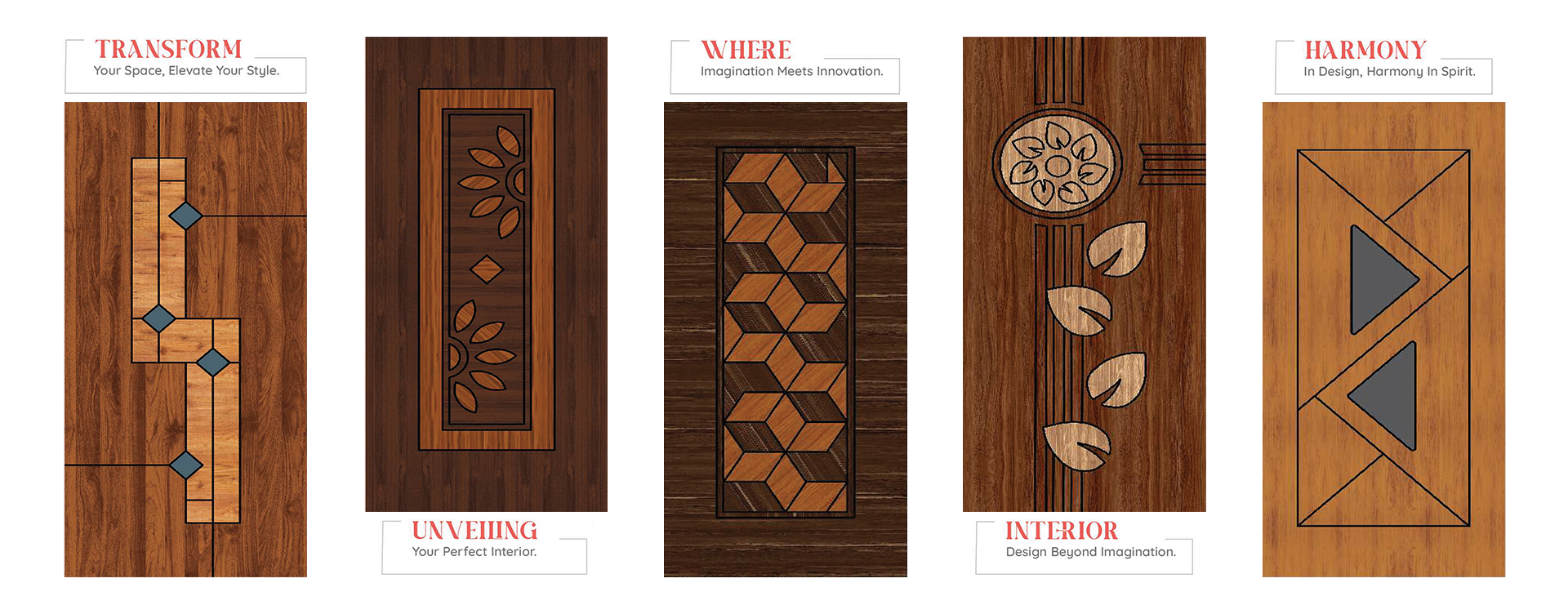
| CNC routing | Premium panel designs (60+ patterns) |
| Digital printing | HD realistic wood grains (100+ designs) |
| Textured finishes | Contemporary & premium appeal |
| Lamination compatibility | Easy interior matching |
This allows distributors to offer high-end aesthetics with zero moisture or termite risk.
Why Importers Prefer WPC Over Wooden Doors ?
| Importer Priority | Wooden Doors | WPC Doors |
|---|---|---|
| Moisture resistance | ❌ | ✅ |
| Termite protection | ❌ | ✅ |
| Batch consistency | ❌ | ✅ |
| Claim risk | High | Low |
| Long-term cost control | Weak | Strong |
| Scalability | Limited | Excellent |
Distributors report 20–30% lower after-sales costs after switching from wooden doors to WPC doors.
Regional Demand Indicators
| Region | Key Driver |
|---|---|
| Middle East | High humidity & termite exposure |
| Africa | Low maintenance & price stability |
| Southeast Asia | Moisture resistance & urban housing |
| Institutional projects | Uniformity & durability |
Read More About GCC’s Building Materials Product Range
In GCC and African markets, WPC doors now account for 50–70% of door volumes in large residential and hospitality projects.
How GCC Supports Importers in WPC Door Sourcing ?
GCC treats WPC doors as a structured export program, supplying doors and frames together,not as isolated SKUs.
GCC supplies export-grade WPC doors to distributors across the Middle East, Africa, and Asia, combining:
| Importer Need | GCC Capability |
|---|---|
| Stable supply | Export-grade, audited production |
| Sizes & designs | Standard sizes + 100+ design options |
| OEM / private label | Full branding support |
| Logistics | Mixed containers with panels & profiles |
| Documentation | Complete customs & export compliance |
Citations & Market References
https://www.grandviewresearch.com/industry-analysis/doors-market
https://www.statista.com/markets/400/topic/481/construction/





 1
1
 0
0 0
0 0
0