July 21, 2026
Future of PVC Foam Boards in Furniture, Signage & Interior Design
Why Future of PVC Foam Boards in Furniture, Signage & Interior Design ? PVC foam boards are moving from a...

Why Upholstery Fabric Is Trends in India ?
The upholstery fabric market is no longer a background input in furniture manufacturing. In 2026, the fabric a piece of furniture wears has become one of the most powerful drivers of premium sales – and one of the sharpest differentiators between a product that sells at full margin and one that gets discounted to clear stock.
The global upholstery fabric market was valued at USD 6.44 billion in 2026 and is projected to reach USD 9.01 billion by 2032, growing at a CAGR of 5.6%. The broader combined foam and fabric market is growing from USD 68 billion in 2024 to over USD 102 billion by 2030, at a sustained 6.8% CAGR.
Behind these numbers is a consistent signal: buyers across all market segments are upgrading their fabric specifications, paying more for quality, and rewarding suppliers who understand what they need.
The Market at a Glance
| Metric | Value |
|---|---|
| Global Upholstery Fabric Market (2026) | USD 6.44 billion |
| Forecast (2032) | USD 9.01 billion |
| CAGR (2026 – 2032) | 5.6% |
| Combined Foam + Fabric Market (2024) | USD 68 billion |
| Combined Market Forecast (2030) | USD 102 billion |
| Asia-Pacific Share of Global Exports | ~70% |
| Fastest Growing Destination Markets | GCC, Africa, Southeast Asia |
| Key Exporting Countries | India, Vietnam, China |
Asia accounts for approximately 70% of global upholstery fabric exports, with India and Vietnam leading the export supply chain for mid-to-premium categories. For buyers across the Gulf, Europe, and Africa, Asia remains the most cost-competitive sourcing base – but what those buyers are demanding from Asian manufacturers has changed substantially in 2026.
Price alone no longer wins orders. Specification depth, documentation, certification, and trend alignment are now the deciding factors.
Read More About Source Furniture Foam & Upholstery from Asia
Why Fabric Has Become a Strategic Procurement Decision ?
Many furniture businesses still treat upholstery fabric as a cost line – something to be minimised, standardised, and specified only under pressure from the sales floor. The market has moved decisively away from this approach, and the businesses still operating on it are losing margin and market share.
The shift is happening across every buyer segment :
The practical implication for distributors and manufacturers: getting the fabric right is not a finishing touch – it is the core of the product value proposition.
Trend 1 : The Great Colour Shift – From Cool Grays to Warm Earth Tones
The single most commercially significant colour shift in 2026 is the decisive movement away from the cool gray and stark white palettes that dominated interiors for the better part of a decade. The design industry has reached a turning point.
“Mayer has firsthand witnessed a seismic shift with spaces that feel warmer, richer, and more expressive without sacrificing performance,” notes Mayer Fabrics’ trend report. Cool grays no longer communicate contemporary – they communicate clinical.
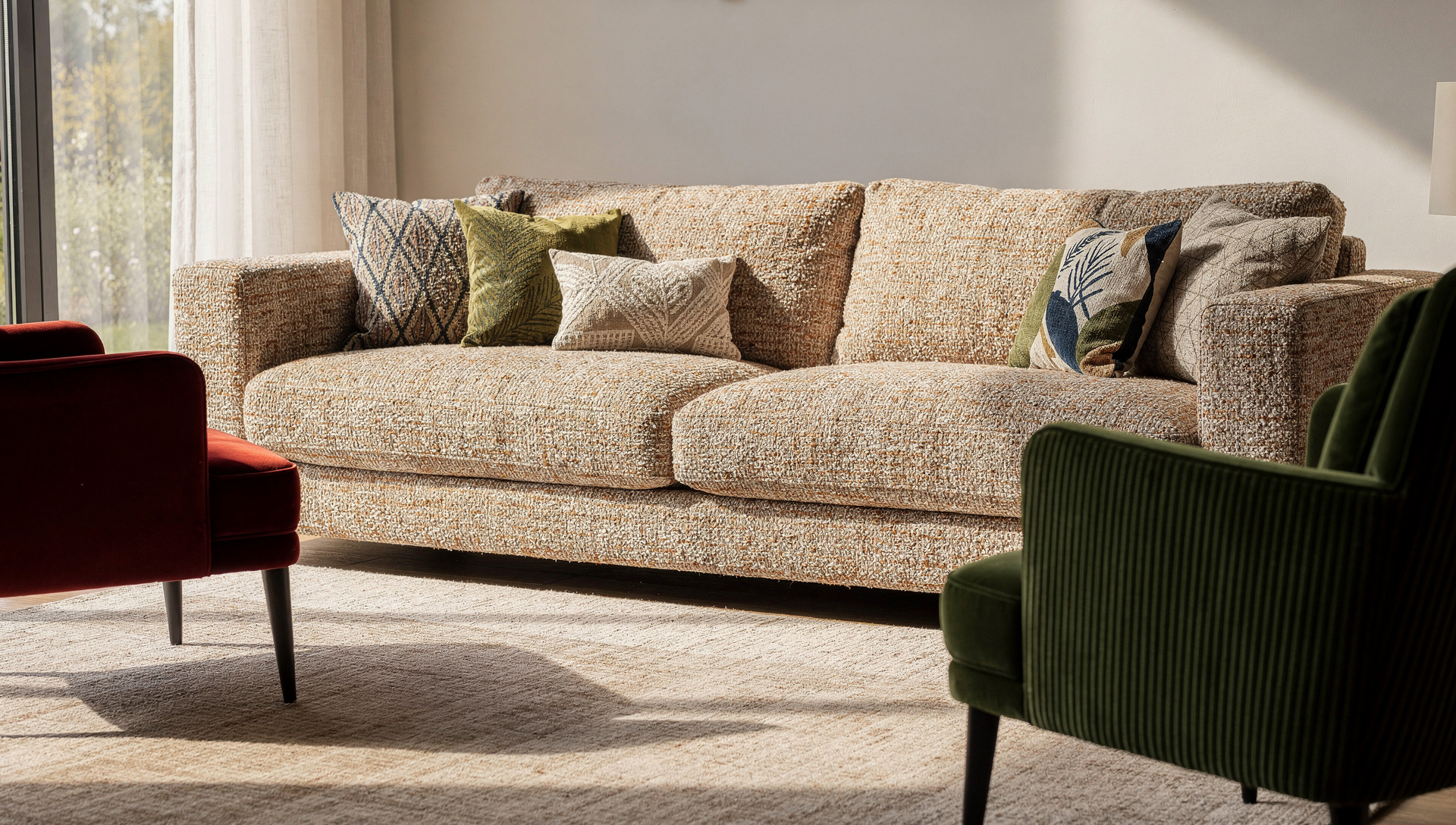
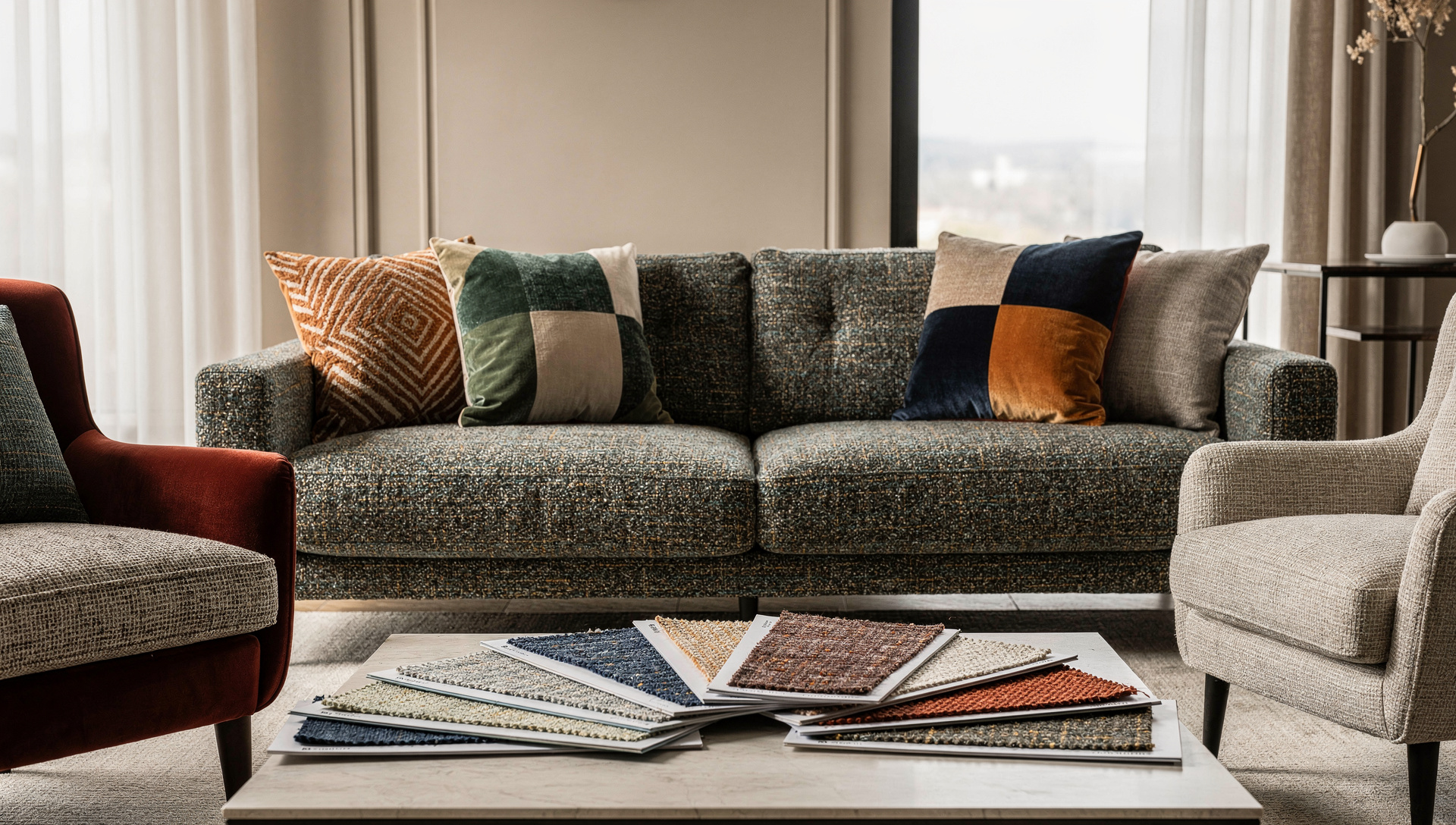
What is replacing them are warm, earthy, grounded palettes that feel both timeless and emotionally resonant. Beige, sand, camel, clay, and mushroom tones are performing strongly across all markets. Deeper accent shades – oxblood burgundy, moody olive, tobacco brown, rust, and aubergine – are driving sales of statement and occasional pieces.
“Shell pink” is emerging as a notable new neutral – a warm, muted tone that works across residential and commercial settings without reading as overtly feminine. For buyers building export ranges, the practical implication is clear: leading with warm neutrals as the collection foundation and offering deep accent shades as hero SKUs is the formula driving the highest retail sell-through in 2026.
Colour Direction by Market
| Colour Family | Best Performing Markets | Application |
|---|---|---|
| Warm Beige / Camel | Global – residential and commercial | Primary sofa and seating fabric |
| Greige / Warm Putty | Gulf, Europe | Living room, bedroom seating |
| Moody Olive / Earthy Green | Europe, Gulf premium | Statement sofas, dining chairs |
| Charcoal / Deep Slate | Commercial, global | Contract and office seating |
| Terracotta / Rust | Africa, Europe | Accent chairs, occasional pieces |
| Oxblood / Burgundy | European premium retail | Occasional sofas, armchairs |
| Shell Pink | UK, Europe, Gulf residential | Bedroom and boutique seating |
| Off-White / Ivory | Gulf luxury residential | Premium lounge, hospitality |
GCC supplies the full range of trending colourways across velvet, linen-look, boucle, and chenille categories: View Fabric Rolls · View Velvet & Linen
Read More About Why Importers Prefer India & Vietnam for Upholstery Materials ?
Trend 2 : Texture Is the New Statement – Boucle, Chenille, and Tactile Weaves
If colour is the headline of 2026 upholstery, texture is the story. “Texture is no longer an accent of patterns. It’s a focal point,” states Mayer Fabrics’ commercial interiors trend report. Across every market segment – luxury residential, hospitality, contract commercial – tactile fabrics are the defining category driving premium furniture sales and margin expansion.
Boucle is the most commercially visible texture of the moment. Its looped yarn structure creates a dimensional, architectural finish that photographs exceptionally well for e-commerce and retail display, while delivering genuine warmth and comfort in use.
A more refined, blended-yarn version with architectural precision is emerging alongside the classic loose loop, extending boucle’s commercial appeal into contemporary contract and hospitality settings.
Boucle-upholstered sofas consistently command a 25 – 40% price premium over plain-weave equivalents in Gulf and European markets – making it one of the highest-margin fabric decisions a distributor or furniture brand can make.
Beyond boucle, the broader texture direction includes:
The commercial rule: textured solids reduce taste risk. They travel better across regions than printed fabrics and deliver higher perceived value at the same unit cost.
GCC supplies boucle, chenille, jacquard, microsuede, and textured weaves : View Fabric Rolls
For furniture manufacturers pairing premium textured fabrics with appropriate foam systems : View Sofa Foam · View HR Foam
Trend 3 : Performance Fabrics and Performance Velvets – The Non-Negotiable Upgrade
Performance fabrics are no longer a niche category for families with children and pets. They have become the standard specification across commercial interiors, hospitality procurement, and an increasing share of mid-to-premium residential furniture.
The reason is simple: consumers and specifiers have discovered that they do not have to choose between beautiful and practical. The technology has closed the gap entirely.
“Clients are increasingly savvy and want performance fabrics to look indistinguishable from luxury textiles,” says Philip Thomas Vanderford of Studio Thomas James. Kathy Kuo of Kathy Kuo Home confirms: “Performance velvets, chenilles, and linen-like blends have all been highly requested lately.”
Performance velvet is the category doing the most to redefine premium upholstery in 2026. It delivers a deep, matte pile and rich colour – everything that made traditional velvet desirable – now combined with water-repellent treatment, anti-crush pile technology, and Martindale abrasion ratings that make it viable for commercial specification.
Leading colourways include olive, deep teal, rust, dusky rose, and midnight blue.
What Buyers Need to Verify in Performance Fabrics ?
| Specification | Residential Minimum | Commercial Minimum |
|---|---|---|
| Martindale rub cycles | 30,000 | 100,000+ |
| Colourfast rating (ISO 105-B02) | Grade 4 | Grade 5 |
| Fire retardancy | BS 5852 Source 1 & 2 | Crib 5 / IMO A.652(16) |
| Fluid resistance | Water-repellent spray | Full liquid barrier |
| Cleaning protocol | Spot clean (code W or S) | Full wet clean / steam clean |
| Antimicrobial treatment | Optional | Required for healthcare, food & beverage |
For commercial furniture projects requiring fire-rated foam systems alongside performance fabrics – hotels, healthcare, transport seating – GCC supplies certified flame-retardant foam: View Performance Fabrics · View Velvet & Linen · View Flame-Retardant Foam
Read More About Why HORECA Buyers Prefer India & Southeast Asia Imports ?
Trend 4 : Performance Linens and Outdoor Fabrics – Practicality Meets Aesthetic
Performance linen has moved from designer novelty to mainstream commercial specification in 2026. The category solves a long-standing sourcing challenge: natural linen has strong design appeal – its texture, slub, and organic warmth align perfectly with the earthy interior direction driving premium sales – but natural linen’s dimensional instability, high cost, and inconsistency at export scale make it impractical for volume furniture manufacturing.
Performance linen addresses all of this. Engineered to look and feel like natural linen while delivering stain resistance, dimensional stability, and 50,000+ Martindale rub cycles, it has become the specification-of-choice for Gulf hospitality lobby seating, restaurant chairs, and premium bedroom furniture – markets where the organic aesthetic is commercially valuable but natural materials would fail within months of heavy use.
Outdoor upholstery fabric represents one of the fastest-growing demand categories in Gulf, African, and Southeast Asian markets – and one of the most underserved categories in export sourcing. The expansion of rooftop restaurants, outdoor hospitality venues, poolside residential spaces, and commercial landscaping projects is creating sustained, growing demand for fabric that can perform in direct sunlight, high humidity, salt air, and repeated cleaning cycles.
What Outdoor Fabric Specification Require ?
GCC supplies performance linen and UV-resistant outdoor fabric : View Velvet & Linen · View Outdoor Fabric · View Fabric Rolls
Trend 5 : Pattern Returns – Intentional, Global, and Commercially Curated
After an extended period of minimalism, pattern is making a confident commercial comeback in 2026 – but it is arriving with a sophistication and intentionality that distinguishes it from previous trend cycles. “After years of minimalism, interiors are embracing more expressive prints and patterns. From organic to artistic shapes and linework, bold upholstery creates focal points and visual identity,” notes the Mayer Fabrics commercial interiors report.
The key commercial dynamic behind this shift is the rise of what designers are calling the occasional piece – a chair, accent sofa, or ottoman that functions as a statement object in the room rather than a primary seating solution.
Because these pieces are not subject to daily sustained wear, they offer creative freedom to experiment with striking prints and fabrics chosen for visual impact rather than resilience alone. This has opened a commercially significant product tier between basic seating and full premium upholstery, where pattern and distinctive fabric choice justify a price premium without requiring performance-grade specifications.
Global design influences are reshaping collection direction, with suppliers drawing from craft traditions across multiple cultural contexts:
The sourcing implication for distributors: a curated 20% of range as pattern-driven occasional pieces against 80% textured solids and performance fabrics is the commercial formula delivering the strongest overall collection performance in 2026.
GCC supplies patterned, jacquard, and printed fabric rolls, plus sofa covers and slipcovers for retail display and collection protection : View Fabric Rolls · View Sofa Covers & Slipcovers · View Sofa Covers
Trend 6 : Sustainable Fabrics and Leather – Two Markets, One Direction
Sustainability is no longer a premium niche or a marketing claim – it is an active purchasing qualification in European markets and a rapidly growing requirement in Gulf commercial and hospitality procurement. Institutional buyers in Europe – hotel groups, office developers, healthcare operators – now require OEKO-TEX Standard 100 or Global Recycled Standard (GRS) documentation as a condition of approval.
For export distributors targeting European retail channels, sustainability certification is now a market access requirement – not an optional premium. Fabrics without OEKO-TEX or equivalent certification are increasingly excluded from premium retail listings, interior design specifications, and commercial procurement shortlists.
What sustainability means in practical fabric sourcing terms:
Leather is simultaneously reclaiming its premium positioning with a distinctly contemporary aesthetic direction. Designers report strong consumer demand for genuine leather in warm, natural tones – desert tan, aged cognac, and deep tobacco – finishes that age with character and signal investment-piece quality.
For export markets across Gulf and Africa, leather and PU leather upholstery consistently command the highest average selling prices in commercial seating.
| Leather / Leather-Alternative | Best Application | Key Market |
|---|---|---|
| Full-grain leather (natural, aniline) | Premium residential, statement pieces | Gulf luxury, European premium |
| Desert tan / aged cognac pigmented leather | Contemporary classic sofas | Gulf, Europe |
| PU leather (polyurethane) | Office seating, easy-clean commercial | Gulf, Africa, Asia |
| Bonded leather | Volume commercial projects | Africa, Southeast Asia |
| PVC leather (heavy-duty) | High-traffic commercial, transport | Commercial, industrial |
GCC supplies sustainable and OEKO-TEX compliant fabric options, plus the full range of PU, PVC, and bonded leather for upholstery export : View Fabric Rolls · View Synthetic Leather
For premium seating products combining leather with memory foam or HR foam cores : View Memory Foam · View HR Foam
Trend 7 : OEM and Private Label Fabric Programmes – Building Your Own Brand
The most commercially sophisticated buyers entering the upholstery fabric market in 2026 are not asking to source what everyone else is selling. They are building their own branded fabric ranges.
OEM and private-label fabric programmes allow international distributors, furniture brands, and retailers to control their own product identity – removing direct price comparison, strengthening customer loyalty, and building brand equity that belongs to them rather than the manufacturer.
The OEM model in upholstery fabric has historically been associated with large-volume buyers. That has changed. India’s manufacturing ecosystem now supports flexible OEM programmes at mid-tier volumes – allowing distributors to build proprietary ranges without the minimum commitment thresholds that made OEM impractical for smaller buyers in the past.
What an OEM Upholstery Fabric Programme Includes ?
The long-term commercial value of an OEM programme is brand equity. Once a distributor’s customers associate a colour, texture, or fabric range with that distributor’s brand – and can only source it through them – the relationship becomes much harder for competitors to undercut on price alone.
GCC operates OEM and private-label fabric programmes across all upholstery fabric and foam categories : View Fabric Rolls · View Velvet & Linen · View Synthetic Leather
Read More About Why OEM Furniture Hardware Manufacturing Is Growing in India ?
Requirements by Destination Market
Understanding what destination markets specifically require from upholstery fabric is essential for sourcing decisions. Getting this wrong means stocking fabric that sits in a warehouse rather than reaching a showroom floor.
| Market | Key Fabric Requirements | Key Fabric Categories |
|---|---|---|
| UAE / Saudi Arabia / Gulf | UV colourfast, stain resistant, fire retardant for hospitality, premium velvet | Performance velvet, performance linen, PU leather |
| UK / Germany / Europe | OEKO-TEX / REACH compliant, BS 5852, 30,000+ Martindale, sustainable fibres | rPET fabrics, performance linen, certified velvets |
| Kenya / Nigeria / Africa | Durability, easy-clean, moisture resistance, accessible pricing | Chenille, microsuede, bonded leather, performance fabrics |
| Southeast Asia | Lightweight, mould-resistant, natural-look synthetics | Microsuede, performance linen, outdoor fabric |
| Hospitality (global) | 100,000+ Martindale, antimicrobial, full fire documentation | Commercial-grade performance velvet, FR foam systems |
How Global Connect Corporation (GCC) Supplies Upholstery Fabrics for Global Buyers ?
Global Connect Corporation (GCC) is one of India’s leading exporters and manufacturers of upholstery fabrics, furniture foam, and related materials – supplying furniture manufacturers, distributors, hospitality procurement teams, and interior fit-out contractors across the Gulf, Africa, Europe, and Southeast Asia.
With 200+ manufacturing units, 500+ completed export shipments, and active supply to 12+ countries, GCC does not operate as a trading agent or marketplace. GCC is a direct exporter with full accountability for specification, quality control, OEM execution, certification documentation, and on-time delivery.
That distinction matters: buyers are not buying from a broker with no accountability – they are working with a partner whose reputation depends on execution.
GCC’s Upholstery Fabric & Foam Product Range
| Category | Products | Product Page |
|---|---|---|
| Fabric Rolls | Velvet, linen-look, boucle, chenille, microsuede, performance fabrics, jacquard | View Products |
| Velvet & Linen | Velvet fabric, linen fabric, velvet-linen blends | View Products |
| Synthetic Leather | PU leather, PVC leather, bonded leather for upholstery | View Products |
| Sofa Covers & Slipcovers | Stretch covers, fitted covers, decorative slipcovers | View Products |
| Sofa Covers | Standard and custom sofa covers | View Products |
| Outdoor Fabric | UV-resistant, waterproof outdoor upholstery fabric | View Products |
| Mattress Foam | HR foam, memory foam, PU foam for mattress manufacturing | View Products |
| Sofa Foam | High-resilience foam, soft foam, firm foam for sofa manufacturing | View Products |
| Flame-Retardant Foam | FR foam for commercial and hospitality applications | View Products |
| Memory Foam | Viscoelastic memory foam for premium seating and mattresses | View Products |
| HR Foam | High-resilience foam for contract and residential furniture | View Products |
To discuss upholstery fabric sourcing, OEM fabric programmes, or consolidated furniture material supply:
Call or WhatsApp : +91 99785 55485
Email : [email protected]
Website : www.gccoverseas.com





 0
0
 0
0 0
0 0
0