July 21, 2026
Future of PVC Foam Boards in Furniture, Signage & Interior Design
Why Future of PVC Foam Boards in Furniture, Signage & Interior Design ? PVC foam boards are moving from a...

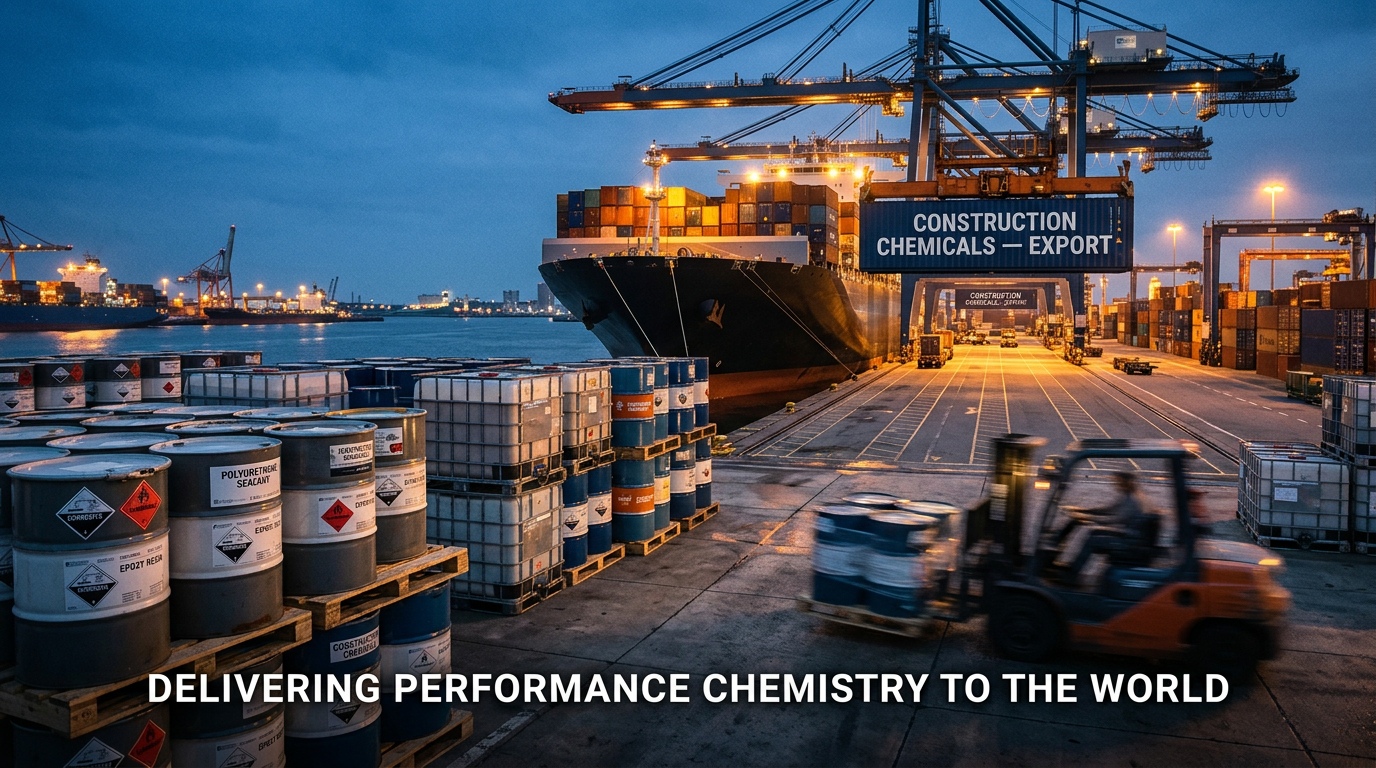
Best Construction Chemical Export Companies for Global Buyers
Construction chemicals have evolved from optional additives to essential components of every modern building project. Without the right waterproofing system, a basement floods. Without the right admixture, concrete cracks under thermal stress. Without proper tile adhesive, finishes fail within months.
According to industry research, the global construction chemicals market was valued at USD 61.8 billion in 2026 and is projected to reach USD 89.9 billion by 2033, growing at a CAGR of 5.5%. That growth is fueled by rising infrastructure spending, green building mandates, and growing demand for repair and rehabilitation systems.
The Market by the Numbers
Global Construction Chemicals Market Snapshot
| Metric | Value |
|---|---|
| Global Market Size (2026) | USD 61.8 billion |
| Projected Market Size (2033) | USD 89.9 billion |
| CAGR (2026-2033) | 5.5% |
| Key Growth Drivers | Infrastructure spending, green building mandates, repair/rehabilitation activities |
| Largest & Fastest Growing Region | Asia-Pacific |
Part 2 : Key Construction Chemical Categories
Construction chemicals cover a wide range of product types, each serving specific structural and finishing purposes. For international buyers, understanding these categories is critical to evaluating whether an exporter can truly meet project requirements.
Major Construction Chemical Product Categories
| Category | Key Products |
|---|---|
| Waterproofing Systems | Waterproofing Coatings · Repellent Coatings · Joint Sealants · Compounds · Cementitious · Liquid Membranes |
| Tile Adhesives & Grouts | Tile Adhesive · Cement Grouts · Epoxy Adhesive · Polymer Adhesive |
| Concrete Admixtures | Air Entrainers · Accelerators · Water Reducers · Plasticizers |
| Sealants & Joint Fillers | Silicone Sealants · Polysulphide Sealants · Polyurethane Sealants |
| Bonding Agents & Repair Mortars | Epoxy Bonding Agent · Latex Bonding Agent · Non-Shrink Mortars · Polymer Mortars |
| Grouts & Anchoring Compounds | Precision Grouts · Cementitious Grouts · Anchoring Compounds · Hybrid Anchoring |
| Curing & Surface Enhancers | Curing Compounds · Surface Hardeners · Acrylic Fillers · Sealers & Enhancers |
Buyers importing for infrastructure, hospitality, industrial, or residential projects typically require products across several of these categories simultaneously, which makes multi-category sourcing capability a critical selection criterion.
The 2026 Challenge – Why Sourcing Has Gotten Harder ?
Construction chemical prices increased 15-27% in 2026 due to raw material supply disruptions, including impacts from the US-Iran conflict on petrochemical feedstocks. Key disruptions include methanol shortages affecting formaldehyde-based products, isocyanate supply pressure on polyurethane systems, and naphtha price surges flowing through to ethylene and propylene derivatives.
Indicative Price Movements in 2026
| Product | 2025 FOB Price | 2026 FOB Price | % Change |
|---|---|---|---|
| Polyurethane Waterproofing Membrane (per kg) | USD 2.50-3.00 | USD 3.50-4.50 | +40-50% |
| Tile Adhesive – Standard Grade (25kg bag) | USD 6-8 | USD 7.50-10 | +20-25% |
| Silicone Sealant (per cartridge) | USD 0.90-1.20 | USD 1.10-1.50 | +15-25% |
| Epoxy Bonding Agent (per kg) | USD 3.50-5.00 | USD 4.50-6.50 | +25-30% |
| Cementitious Waterproofing (25kg bag) | USD 7-9 | USD 8.50-11 | +20-25% |
| Concrete Admixture – Plasticizer (per litre) | USD 0.80-1.20 | USD 1.00-1.50 | +20-30% |
Note: Indicative FOB ranges based on market conditions. Actual pricing varies by volume, specification, and destination.
This pricing volatility makes exporter selection more critical than ever. Importers need partners with stable manufacturing access, verified raw material sourcing, and the ability to provide pricing commitments rather than constantly revising quotes.
Read More About GCC’s Building Materials Product Range
What Global Buyers Should Look For in an Exporter ?
Before evaluating specific companies, procurement teams should assess these critical selection criteria:
| Selection Factor | Why It Matters |
|---|---|
| Quality certifications | ISO 9001, ISO 14001, CE marking, ISI standards ensure product consistency |
| Product range breadth | Single-source suppliers reduce procurement complexity and freight cost |
| Technical documentation | COA, TDS, MSDS, origin certificates required for customs and compliance |
| Export track record | Evidence of reliable international execution across multiple shipments |
| Manufacturing capacity | Ability to scale supply to match demand growth |
| Packaging quality | Chemical packaging failures create liability and claims |
| Multi-category capability | Reduces fragmentation, consolidates freight cost |
| Regional market experience | Familiarity with destination building codes and climate conditions |
Leading Construction Chemical Export Companies in 2026
The construction chemical export landscape has two primary types of players: large global technology companies that control formulation IP and institutional distribution, and flexible structured export partners that operate through verified manufacturing networks and serve mid-sized importers, distributors, and project procurement teams.
Below is an honest breakdown of the major names global buyers encounter in 2026.
1. Global Connect Corporation (GCC)
Active Markets : UAE, Saudi Arabia, Qatar, Oman, Kuwait, Bahrain, UK, Germany, Kenya, Tanzania, Nigeria, and 12+ countries.
GCC operates as a structured international export partner – supporting buyers across the Gulf, Africa, Europe, and other markets through verified manufacturing networks and export-grade operational systems.
GCC’s construction chemicals portfolio covers the full range of categories that importers, distributors, and project contractors typically require.
GCC’s Construction Chemicals Product Range
| Metric | GCC Capability |
|---|---|
| Manufacturing Units | 200+ |
| Export Shipments Executed | 500+ |
| Countries Supplied | 12+ |
| Export Model | Structured International Supply |
How GCC Solves Buyer Challenges ?
| Importer Challenge | GCC Solution |
|---|---|
| Fragmented sourcing | One vendor for waterproofing, adhesives, admixtures, sealants, repair mortars |
| Quality inconsistency | Third-party inspection; batch-specific COA and TDS documentation |
| Documentation delays | Complete export paperwork – MSDS, COA, TDS, packing declarations |
| Freight inefficiency | Chemicals consolidated with hardware, steel, laminates, and tiles in one container |
| Finding reliable partners | 500+ export shipments; proven international track record across 12+ countries |
Read More About GCC’s Steel Product Range
2. Sika AG – The Swiss Technology Leader
Sika AG is one of the world’s most recognized names in construction chemicals, offering an extensive portfolio of concrete admixtures, waterproofing systems, sealants, bonding agents, and structural repair systems – known for high-performance specification-grade formulations.
| Aspect | Detail |
|---|---|
| Best for | Large institutional buyers, major infrastructure projects, national-scale distributors |
| Consideration for importers | Premium pricing; rigid MOQ structures; limited flexibility for mixed-product consolidation |
4. MAPEI – The Italian Formulation Specialist
MAPEI is a global leader in adhesives, sealants, and chemical systems for construction, especially recognized for tile adhesives, floor installation systems, and waterproofing for construction and renovation.
| Aspect | Detail |
|---|---|
| Best for | EU-bound projects, green building certified specifications |
| Consideration for importers | Premium European pricing; less accessible for cost-sensitive or emerging market buyers |
5. Fosroc International
Fosroc is a well-established name in construction chemicals, particularly strong in Gulf and African markets. The company supplies admixtures, waterproofing systems, repair mortars, and sealants for infrastructure and industrial projects.
| Aspect | Detail |
|---|---|
| Best for | Gulf and Africa regional distributors; infrastructure-scale procurement |
| Consideration for importers | Institutional-scale by design; limited direct export flexibility for mixed-product sourcing |
6. Regional Exporters (India, China, Southeast Asia)
Thousands of smaller exporters across Asia supply construction chemicals internationally.
| Strength | Risk |
|---|---|
| Lower pricing (20-40% below European equivalents) | Inconsistent quality and batch variation |
| Flexible MOQs for trial orders | Weak or absent quality control systems |
| OEM and private-label options available | Limited export documentation support |
| Multi-category sourcing possible | No post-shipment accountability |
Consideration for Buyers: Regional exporters can deliver value for commodity products like basic admixtures. However, verification is essential. Request factory audits, order samples, and use third-party inspection before committing to bulk orders.
Read More About GCC’s Construction Chemical Range
The Importer’s Dilemma
Consider a real sourcing scenario: a contractor in Nigeria needs cementitious waterproofing, tile adhesive, concrete admixtures, silicone sealants, and epoxy bonding agents for a commercial building project.
| Option | Result |
|---|---|
| Option A: Source waterproofing from Sika, adhesive from MAPEI, admixtures from a regional trader | Three suppliers, three quality standards, three shipment schedules, three sets of documentation – and three times the coordination risk |
| Option B: Approach GCC | One vendor. One quality standard. One shipment. One set of documentation. One point of contact from PO to delivery |
This is the operational gap GCC fills – and why structured export partners are increasingly preferred by mid-to-large volume importers and distributors globally.
What to Check Before Placing a Bulk Chemical Order ?
Pre-Order Verification Checklist
| Sr. No. | Action | Why It Matters |
|---|---|---|
| 1 | Request ISO certifications | Confirms quality management systems are in place |
| 2 | Order pre-production samples | Verifies product meets your specifications before bulk commitment |
| 3 | Clarify packaging and labeling | Prevents customs delays and compliance rejections |
| 4 | Review inspection protocol | Third-party inspection reduces quality risk significantly |
| 5 | Confirm documentation standards | COA, TDS, MSDS, and origin certificates required for most markets |
| 6 | Check regulatory compliance | CE, REACH, ISI, or equivalent standards depending on destination |
| 7 | Get a milestone delivery schedule | Production start to QC to container loading to ETD/ETA |
Why India Is the Preferred Construction Chemical Sourcing Base in 2026 ?
India has emerged as one of the top five construction chemical exporting countries globally, alongside Germany, China, the UK, and South Korea. A strong combination of manufacturing scale, raw material access, technical capability, and competitive pricing makes India increasingly attractive for international buyers.
| Factor | Advantage |
|---|---|
| Cost competitiveness | 20-40% lower production cost than European alternatives |
| Manufacturing depth | Strong chemical clusters in Gujarat, Maharashtra, and Rajasthan |
| Product range | Complete construction chemical range available domestically |
| Export infrastructure | Growing number of export-certified manufacturing units |
| EU-India FTA trajectory | Expected to reduce duties on Indian chemical exports to Europe |
| UK-India FTA | Further duty reductions on Indian building material exports to the UK |
To Discuss Your Requirement for Construction Chemicals:
Call or WhatsApp: +91 99785 55485Email: [email protected]Website: www.gccoverseas.com
Citations & Market References :





 1
1
 0
0 0
0 0
0